Showing posts with label joint health. Show all posts

Tuesday, 10 April 2018

4 Fact-Checks On Osteoarthritis

Osteoarthritis affects approximately 10% of all Canadians. It's a condition characterized by the degeneration of cartilage within a joint and, at more-advanced stages, the addition of irregular bony growth in those spaces, often causing debilitating pain and loss of function.


The diagnosis of OA can be a terrifying reality for people, as it's immediately seen as a one-way ticket of progressing pain, dynfunction, and an inevitable joint replacement. How about we take a look at the common believes regarding OA, however, and see what there is to learn?

Belief: My X-Rays Show Arthritic Changes; Therefore, I Have OA

Verdict: Sometimes, but not really.


I allude to this quite frequently in both my practice and my writings. Individuals often get scared by the fact that their x-ray results show a degenerative change in their joints, whether it be their spine, knee, or shoulder.

It needs to be remembered, though, that these imaging findings are not necessarily indicative of a pathological condition. More often than not, a degenerative change within a joint is a result of the natural aging process in the same way that your skin wrinkles with age or your hair turns gray.

In fact, we've more or less shown that there's no real correlation at all between these findings and the occurrence of pain, present or future.

Yes, if you DO have a true case of OA, it will show as a positive on an x-ray, but not every positive on an x-ray is an accurate diagnosis for OA. Essentially, every apple is a fruit, but not every fruit is an apple.

[Insert Joke]

Belief: Osteoarthritis Is Caused By Overuse/Wear and Tear

Verdict: Sorta, but not in the way you think.


We often think of OA as being caused by years and years of constant use of a joint, such as the belief that runners will develop it in their knees and hips.


My joint space is a raging hellfire.
Inherently, we know this to be untrue. If it was fact, then every active person in the world would have arthritis in all of their joints simply because they're using them all of the time.

The "wear and tear" of OA is a real thing, but the risk factors involve the use of the joint with the presence of other conditions such as muscle weakness, lack of proprioception, restricted range of motion, and joint instability.

If you notice, all of those risk factors are actually correctable using exercise. This being said, too much physical activity isn't a risk factor for OA; rather, it's a lack thereof.

Belief: Cracking Your Joints Can Cause OA

Verdict: Hard no.


This is one of the most long-standing myths when it comes to arthritis, so here we go!

Whatever the belief on what is occurring inside a joint during a crack (what does everyone believe, by the way?), the reality is that it's a much more benign event than we used to think.

To put it simply, joints are fluid-filled spaces with the potential for air pockets to collect and build up. When we crack the joint, we're moving and re-positioning the joint in a way that allows those pockets to release, and that's the sound that we're hearing. Is it damaging to the joint? Not in the slightest. So go ahead and continue horrifying your sister by continuing to crack those knuckles!


Belief: If I Have OA, There's No Getting Better

Verdict: Probably Untrue.


Fair enough, there are those cases of osteoarthritis that are so far gone, so debilitating, and so beyond conservative treatment that the only option is a joint replacement. For those of you who aren't quite on that end of the spectrum yet, though, there's still hope!

Remember those risk factors we talked about above? (Muscle weakness, joint instability, etc.) Well, as it turns out, you can address those factors, not only as a preventative measure, but also for treatment after the diagnosis of OA. Doing so can improve the symptoms and often delay or even completely prevent the need for any future joint replacement!

Let's also remember that pain is driven by the nervous system, not necessarily by any physical or structural causes. That being said, treating and exercising those risk factors away can further decrease the neural sensitivity in the area and continue to relieve pain.


The hope is to shine a bit of light on this condition and to help to reperceptualize those who may be affected by it. OA diagnosis can be scary when we aren't made aware that the outcome doesn't have to be a negative one. It needs to be known, however, that osteoarthritis is both preventable and treatable.

Subscribe

Do you like the content that you're reading? Sign up to receive the weekly blog update from Cain Exercise Rehab directly to your email!

Click Here!

Book Now

In the Victoria area and interested in booking an appointment with Cain Exercise Rehab? Follow the link below to book online!

Click Here!

Tuesday, 23 January 2018

Is Running Bad For Your Joints?

You'll be hearing me celebrate the return of running season for the next little while. Running is a fantastic exercise and sport, and I'm more than happy when I see both experienced and brand new runners partaking. However, is running a healthy activity?


It has generally been the common consensus that running is bad for your joints, whether it be for your knees, your hips, or back. Thus, it's often the reason (or excuse) for many people to not partake in any running. It makes sense; too much impact on the joints could totally cause some arthritic development or degeneration in the spine. As we understand it, this is basically the definition of how osteoarthritis onsets, right?

The research journal search was actually extremely easy here. As I was able to find out, between both old and new studies, long-term studies, and cross-analyses, running was almost always found to be unrelated to any development of osteoarthritis in the knee, hip, and spine. At the worst, some studies suggested it to be merely inconclusive.


In fact, one brand new piece of research even found that, as far as intervertebral discs go, running actually promoted more strength and better disc health as opposed to contributing to degeneration!

So what's going on? What actually causes arthritis? Well, recent skeletal examinations are now suggesting that osteoarthritis development has more to do with a lack of physical activity rather than too much of any particular type. This was strengthened by the fact that degenerative joints correlate highly with the morbid obesity seen in many modern-day skeletons.

Furthermore, there may even be mechanisms that actually protect runners from degenerative changes from their spot. While the overall impact and force going through the joints is higher during a running gait, there may be some evidence suggesting that the decreased contact time with the ground actually works to counteract any damaging effects.

All this being said, no, running is not the joint-destroying, pain-inducing activity that many out there believe it is, and there's even the possibility of being a runner if you already do have arthritis. Keep in mind, running, like ANY other activity, can cause injury, whether it be from an accident, poor conditioning, or training error, so don't forget the importance of proper training.


Subscribe

Do you like the content that you're reading? Sign up to receive the weekly blog update from Cain Exercise Rehab directly to your email!

Click Here!

Book Now

In the Victoria area and interested in booking an appointment with Cain Exercise Rehab? Follow the link below to book online!

Click Here!

Tuesday, 21 November 2017

Stable Shoulders (At All Angles)

I've already spoken at length in the past of the importance of keeping your shoulder stabilizers healthy and methods of doing so. We're being neglectful if we think that simply working the delts, pecs, bi's and tri's are all that are needed. However, while you shouldn't simply isolate the large muscles, doing similar isolation of the smaller ones as well are typically not going to be enough to keep your shoulder optimally functional either.

A common training/maintenance error I see is, while many people are mindful when it comes to warming up and strengthening their stabilizers, there's a tendency to still remain in isolated ranges of motion. For instance, even if you're exercising your rotator cuff muscles on the daily, like so...


...is that properly teaching those muscles to be stable and functional in movements like this...


...or this?


Your shoulder doesn't remain in a lowered position with your elbow at your side, so why would you restrict your stability training to that one range? Individuals who need to recover from injury, train for performance, or even just maintain function for every day life need to be hitting their stability work from multiple angles from the shoulder being down at your side to being overhead.


The shoulder is a highly-mobile, multi-angle joint. If you have a range of motion available, make sure the musculature is conditioned to be supportive in each of those angles. You want to be able to keep using those things.


Subscribe to the Weekly Updates

Do you like the content that you're reading? Sign up to receive the weekly blog update from Cain Exercise Rehab directly to your email!

Tuesday, 7 November 2017

The Advantage Of Active Rehab

In the wake of hiked ICBC rates due to an uncontrollable flood of payouts as well as an audit into unethical professional fees to do with claims, it has been a thought of mine recently that there is something not quite working with an insurance system that should be easily covering its costs due to the nature of what it is.

Now, there are many directions to point the blame. One of the articles above discusses how much autobody shops are milking the insurance company with hiked rates, and I'm sure there are therapy clinics who aren't much better in terms of ethics. There's the increase in legal fees as well, due to ICBC's fight against offering higher and fairer initial settlements. We won't even get into the political discussion of what role certain provincial parties may have played in creating this mess.


Whatever the reason, I'm mostly concerned with solutions to the problem. One way that I can see it - one that would save much in terms of time and money on the side of both the insurance companies, the legal teams, and the clients - is the shift towards more active approaches to injury rehab.

I don't often feel the need to talk about the importance of exercise for recovery since, to myself, it's a no-brainer. However, I remind myself that the world we live in isn't necessarily one that's focused on exercise and movement the same way that an Athletic Therapist is. But I digress...

It's easy to find evidence for my case. Studies are easily comparing the difference between active rehab (which includes movement and exercise prescription) to passive rehab (which is treatment-centered only) and consistently shows an improvement in client-condition and function when you get people moving.


The implications of this are easy to figure out. With more control of recovery being given to clients - by way of prescribed home exercises - the result is more-optimal recovery through means of fewer appointments and thus, less money! 

So while saving ICBC from paying a few less $70 appointments isn't quite comparable to the thousands of dollars that car shops might be milking, if the trend catches on, it can make a difference. And obviously, this doesn't solely apply for motor vehicle injury claims; individuals paying out of pocket for their recovery would of course appreciate paying a little less.

The advantage is clear. Exercise rehabilitation is the way to go!

Subscribe

Do you like the content that you're reading? Sign up to receive the weekly blog update from Cain Exercise Rehab directly to your email!

Click Here!

Book Now

In the Victoria area and interested in booking an appointment with Cain Exercise Rehab? Follow the link below to book online!

Click Here!

Tuesday, 12 September 2017

Plantar Fasciitis (And The Nerves That Imitate It)

I thought that this would be a good post to make, as I've now encountered a handful of clients with this issue. Individuals have come to see me with complaints about plantar fasciitis that has been persistent to any amount of stretching or foot massage.


In these instances, my typical process was to assess the injury but have difficulty replicating their pain using any ranges of motion or muscle testing at the foot, ankle, or knee. Pain with pressure was common, however.

After attempting to treat the plantar fascia with no benefit, I had to flip switches and try something different. Having some experience with this before (and with the wonderful handiness of the internet) I zoned in on testing a couple nerves instead.


Most people assume that nerve pains follows the trend of always beginning centrally near the spine and extending down the length of the limb. However, it is only a trend, not a rule. If entrapment of the nerve occurs further than the spine or in several, less severe areas separately, then the symptoms can absolutely manifest at only the end of the limb, like in these "plantar fasciitis" cases.


Both the sciatic and the saphenous nerves have the potential to cause plantar pain that many people may think to be fascial. (Both can be dull, diffuse, or burning pain.) However, upon proper testing where we put the nerve itself on stretch, we were able to determine the root of the cause. Without fail, after treating these clients up at their hips or back instead, we were able to relieve the pain.


Just a good example that therapy and rehab isn't as easy as chasing the pain. Often, you have to go quite a ways up the chain in order to find the cause. In these cases, finding that cause can be a hard thing for clinicians to do, considering that protocol wouldn't normally involve having to rule out joints as high as the spine in cases of foot pain. However, therapist or client, it's important to keep in mind that the body works as whole.

Subscribe to the Weekly Updates

Do you like the content that you're reading? Sign up to receive the weekly blog update from Cain Exercise Rehab directly to your email!

Tuesday, 8 August 2017

7 Athletic Therapy and Rehab Myths

Athletic Therapy is still a growing field, and one that the majority of the public is still not entirely aware or educated about. I can't act like we AT's are martyrs, though; I'm well aware that Physiotherapists and Massage Therapists are also fighting their own battle in trying to raise public awareness on the importance and benefits of their practices.

That being said, here are my top seven myths and misconceptions debunked, not only on Athletic Therapy, but also on rehab and recovery as a whole!

1) Athletic Therapy is only for athletes

It's obvious why this belief exists. Athletic Therapy has its roots in the world of athletic training (akin to the job title in the US) that works primarily with sports-teams. Since those early days, however, Athletic Therapy has branched and spread itself out to being able to address and care for any demographic. "Athletic" Therapy speaks more on the modality of exercise that we specialize in and use to help clients recover rather than on any misconceived exclusivity of target demographic.


2) My insurance won't cover Athletic Therapy

This one may have been more true even as recently as 5-10 years ago. As it stands now, however, Athletic Therapy is receiving more and more widespread coverage with major insurance providers. Great West Life, Manulife, Sunlife, and more are all now known to cover AT; if not all the time, then at least under the right circumstances or based on request.

3) You need a referral to see an Athletic Therapist

I'm going to say that this one is probably untrue. Granted, if your particular extended health plan requires you to attain a doctor's note in order to receive coverage to see an Athletic Therapist, then that's that. However, when it comes to simply seeing an AT on your own accord, any AT will welcome you into their clinic, referral note or not.

4) Athletic Therapy is only for accidents and acute injuries

Indeed, Athletic Therapy is excellent for treating acute injuries resulting from specific accidents. In fact, the sooner and more acute the injury is when we first see a client, the quicker the recovery will be! However, AT's are trained and experienced to work with clients experience chronic and overuse conditions that aren't necessarily labeled as "sports injuries", including long-term low back pain, arthritis, and tendinitis.

5) My x-rays showed that I have something that won't go away, even with rehab

This one is a message that I'm passionate about, but one that's tough to get out there as much as I'd like. As I've written before, x-rays and MRI results are very likely to reveal injuries and conditions that a doctor may be quick to label as a problem. The thing to remember is that, in almost every adult, there are going to be some natural aging changes in your joints that are overdiagnosed as arthritis or degeneration.

Numerous studies consistently show completely asymptomatic patients testing positive for disc bulges or other degenerative changes on imaging. It just goes to show that an Athletic Therapist can definitely return you to pain-free function, even with these occurrences.


6) I need surgery first

When it's been determined that surgery is a necessary intervention, many prospective clients assume that they have nothing to do but wait for the date. However, it's been shown that patients awaiting hip surgery are able to reduce their pain with rehab in the meantime and may be able to improve their post-surgical outcomes. This may have something to do with getting the nervous system trained early for the rehab that will come post-operation or by getting accessory muscles away from the surgical site stronger to support the area. 

On the flip side, perhaps you've been told you need a surgery that's statistically unsuccessful or unnecessary. Oftentimes, conservative rehab is more effective and successful than operating on the area. Granted, Athletic Therapists will always respect the recommendations of medical doctors, but it may still be worth receiving an additional opinion or trying out a few sessions first in order to help assist you in your decision-making.

7) I'm not quite ready to start exercising

Finally, too many individuals who are in a large amount of pain have a misconception that they need to wait until their pain, somehow, settles down on its own before commencing a rehab program. Unfortunately, this often results in further pain and dysfunction as they become less and less active.

Inversely, even if a great deal of pain is present, there is always something that an Athletic Therapist can prescribe a client to do, even if it's the tiniest movement with the neck, hip, or even eyes that will improve that client's condition and outcome.


Subscribe

Do you like the content that you're reading? Sign up to receive the weekly blog update from Cain Exercise Rehab directly to your email!

Click Here!

Book Now

In the Victoria area and interested in booking an appointment with Cain Exercise Rehab? Follow the link below to book online!

Click Here!

Tuesday, 11 July 2017

Cross Syndrome Is Not A Disease

I've spoken to several people lately who have been very concerned with their "cross syndrome" and have sought my advice in correcting it.

For those not in the know, cross syndrome is a term coined by Vladimir Janda in the 80s for a series of muscular and postural imbalances. It signifies the criss-cross pattern of shortening and lengthening of muscles that results in postural imperfections, such as the classic forward shoulder position from tight upper traps and pecs combined with weak neck flexors and lower traps.


These cross patterns occur through both the upper and lower body as termed by Janda. Similar principles exist through the entire kinetic chain overall, not being isolated with just the aforementioned saggital (front and back) planes.

I take issue with the name "cross syndrome", though, as I find that it's regarded with more fear than it should. The term "syndrome" is mistaken by many individuals (usually ones that are self-researching for their own health or working in fitness) to be synonymous with "disease". This is absolutely not the case.

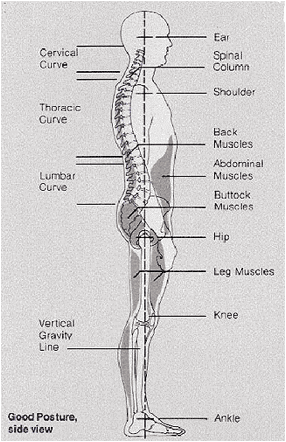
I wrote before about how textbook posture is an unrealistic achievement and a largely-unnecessary goal. These cross patterns (as I prefer to call them) are often correlated to injury, yes, but not causative to them.


Many, many people will walk around with forward heads and rounded T-spines their entire lives and never experience shoulder pain. Anterior pelvic tilt does not automatically signify lower back pain. We need to not fear these postural imperfections and think that they always need to be corrected for.

Obviously, these patterns are something that we pay attention to if there is pain, because they provide the rehab practitioner a good place to start in terms of relieving the symptoms and the mechanics that caused the injury. In absence of a symptomatic dysfunction, though, there's very little to gain by trying to address the "imbalance".

All in all, there's no real problem with wanting to train yourself to stand taller, but we shouldn't be concerned when we look sideways in a mirror and notice "upper cross syndrome". If it ain't broke, don't fix it. If it doesn't hurt, if it doesn't impede your performance or day-to-day activity, it's probably functional.


Subscribe to the Weekly Updates

Do you like the content that you're reading? Sign up to receive the weekly blog update from Cain Exercise Rehab directly to your email!


Tuesday, 27 June 2017

Self-Testing Your Hip Mobility

I did a post a while back regarding the importance of hip mobility for spinal health. I discussed the implications of lumbar spine compensations should the hips not be able to flex and extend properly.

BU T - how common is a lack of these ranges in the hips, really? In that article, I noted that most losses of hip flexion are purely soft-tissue restriction (those darn't hamstrings) while compensations of the spine during extension are likely just due to instability in the core.

In my experience, I've seen very few clients who have a deficit in hip mobility at the joint-level itself in flexion and extension, save for for traumatic accident victims, post-surgical clients, or the elderly.

This isn't to say that it doesn't happen. That being the case, however, considering how many people are aggressively trying to mobilize those ranges at the gym all the time, I'm here to show you some quick ways to self-assess whether you're one of the people who actually requires it. (Pro-tip: You're most likely not one of those people.)

Flexion


Lay down on the floor (not a squishy bed) on your back. Rotate your pelvis all the way forward and make a big gap between your low back and the floor (anterior rotation) and then rotate it back so that the lower back is flattened on the floor (posterior). Now, find the spot directly in between those two end-ranges, which will be your neutral position.

From here, you want to make sure that your hips don't leave that neutral position. Focusing on keeping the pelvis where it is, pull one knee at a time all the way into your chest.

You'll probably notice that you got your knee somewhere between 90 and 120 degrees from the floor. Surprise! You have optimally mobile hip flexion!

Extension


Self-testing your extension will follow a similar pattern. Standing this time, find the a doorway or pole that you can have half of your body up against. Standing with your back to it (one butt-cheek on, one off) find your neutral pelvis position again. Place a hand in the small of your back to ensure that the distance between your back and the surface stays consistent while you extend the free leg back behind you, stopping when you feel your back forced to extend.

An average distance is anything past 0 degrees and up to 30, so if you were able to make it any distance at all, then you're healthy!

My Point

What I'm getting at here is just a demonstration that true flexion and extension hypomobility issues within the joint itself are not common. If you can't flex your legs far, you likely have excessive hamstring tension (removed by the bent knee when we tested). If you're spine deforms in extension, you probably just have an unstable core that's unable to withstand the force generated by hip extension when done dynamically.

If any range in the hip joint is lacking, it's probably rotation, but I'm going to get to that in a future post.

With all that in mind, it's probably time to abandon the banded hip mobility workouts and just start addressing the soft-tissue again like back in the good ol' days.

Subscribe to the Weekly Updates

Do you like the content that you're reading? Sign up to receive the weekly blog update from Cain Exercise Rehab directly to your email!

Tuesday, 30 May 2017

The System Treatments Target (Isn't The Muscular One)

Have you ever had to tenderize beef? It can take a good amount of work to actually get it to soften enough the way you want it. And this is dead meat. It has no bloodflow, muscle tone, outer wrapping (skin) or reflexes to resist the deformity.


That being said, how can we expect to be creating actual mechanical changes to our own muscular tissue using only a foam roller or our hands?  Look at this picture of a cadaver and see how tightly-packed all of that "soft" tissue is! It's not thin and compartmentalized like anatomy textbooks make it look. It's a giant mass of hard, stiff, muscle. Ain't no cylindrical piece of foam changing the structural makeup of that.


So why do we pay clinicians money to massage us? Why do we foam roll? What's with those trigger point balls? Well, if we can't directly affect the muscular system, there's another system that is extremely responsive to these methods...

The nervous system.

The brain: The strongest muscle.
The nervous system is what controls muscle tone, tightness, spasm, cramps, and essentially every other muscle thing that muscles do. We won't go overboard with the exact neuroscience and types of receptors within the tissue, but here we go. When you go in for a massage for a muscle that's seized up or too tense, what the therapist is essentially doing is overriding the stimuli that cause the nervous system to believe that it needs to be tight and contracted, initiating a relaxation effect. It's sometimes quicker, sometimes a more gradual process, but at the end of the day, the nerves are the only true structure affected by mechanical pressure; that is, unless you run over the person's leg with a steamroller. (The above link cites another study demonstrating the absurd amount of force actually required to deform human tissue.) This is the reason why contract-relax techniques and modalities such as electrical stim are able to exist with the same end-goal as massage of muscle relaxation and decreased tone.

Even when it comes to scar tissue built up in a muscle, the treatments that any therapist does is simply promoting the healthy tissue to mobilize better around the scarring. (Long-term changes from exercises-induced bloodflow and tissue stress might have a different effect, however.)

For this reason, I don't subscribe to the belief that massage has to be excruciatingly painful to be effective. In fact, I see it as counterproductive if you're triggering enough pain to create a new spasm response. Also, this is the benefit of exercise rehab in conjuncture with treatments such as massage, mobilizations, or muscle stim. Once we remove the (allegedly) dysfunctional situation of a muscle when it's hypertonic, in spasm, or in too much pain from an oversensitive nervous system, we can then go in to retrain the body's mechanics to work around the physical structures that exist in an optimally-functional manner.

End of the story, the treatments you receive at the clinic, whether it's massage, stim, mobilizations, or contract-relax stretching, are still incredibly useful; just not for the reasons that you thought. The peripheral nervous system reigns with much more power than we're often inclined to think, and I think that by switching gears to focus on the effects of that system as opposed to having tunnel-vision on the muscles and ligaments themselves that we'll be able to advance our abilities in the healthcare and fitness fields.

Bonus Trivia!

We're talking about the nervous system, so take a look at this Michaelangelo comparison and mull it over.


Subscribe to the Weekly Updates

Do you like the content that you're reading? Sign up to receive the weekly blog update from Cain Exercise Rehab directly to your email!


Tuesday, 2 May 2017

Upper Trap Dominance

Spring and summer are upon us and baseball season is here! Not only that, it's also home renovation and yard work season, all of which mean that your shoulders better be in good shape for all the work that they're in for.


If you're already hurting, then it's a good thing you're here to read on.

One of the most common things I see on clients who come in with shoulder injuries (especially the chronic, overuse ones) is the dominance of the upper trapezius muscle. Like many large, easy-to-engage muscles of the body, the upper traps like to act as the overbearing workaholic that does all the work for everyone else in the office. Pulling, lifting overhead, and more, these muscles have a tendency to initiate many large movements at the shoulder that smaller muscles are initially intended to take charge of.  It's too the point that I (mostly) joke about just severing the nerve to the traps to see if can correct things that way.


This habitual dysfunction is a learned one, most likely from our desk job lives and sedentary behavior. (Being seated with arms elevated to high will shrug the shoulders up and result in increased tonicity of the traps.) Past that, poor education about body mechanics and constant reinforcement of using the incorrect muscles at home, at work, etc. grinds these habits in deep as we get used to using the largest and least-fatigueable of the shoulder muscles to do all the work. They're also muscles that are quick to spasm and guard in response to injury (such as whiplash). What's more, the popularity of weighted shrugs at the gym doesn't help, and removal of them from workout routines is, so often, one of the first instructions I give individuals in my office.

Why this is a problem is that this increased activity of the upper traps usually correlates to a weakness of the smaller scapular stabilizers (such as your serratus), both of which result in an excessive upward rotation of the shoulder blade and destabilization of the shoulder girdle.


While remembering that textbook perfect posture is not a realistic thing to have to worry about, if you do experience pain, these mechanics may be involved. Structures can be impinged from the incorrect shoulder positioning, you could have spasm through the upper traps causing neck pain, and you may be finding that your shoulder isn't handling well against impact and trauma.

With this in mind, you can see the importance of keeping those muscles beneath and below the shoulder blade strong and engaged while keeping the upper traps relaxed and ready as a complementary muscle to movement rather than the prime driver. And for crying out loud, stop shrugging at the gym; the only thing it helps is your ego.


Subscribe to the Weekly Updates

Do you like the content that you're reading? Sign up to receive the weekly blog update from Cain Exercise Rehab directly to your email!

Tuesday, 21 March 2017

What Can Speed Bone Healing?

I've been fortunate to never have had experienced a bone fracture in my own life. (I figure that I'll probably get hit by a car in the week following this blog post.) I understand how much fractures are a drag, though. Not being able to do anything except immobilize it and let time heal it enough to start doing any rehab.


A topic that's starting to pop up, however, is if there are modalities which can increase the rate of bone healing and accelerate the recovery process. Well, I decided to surf through the research and see what I could dig up.

Exercise

Let's start with the modality that I'm clearly the most focused on. It's common that weight bearing and physical activity will increase the rate of healthy bone formation in healthy populations and those with osteoporosis. But can early exercise while a fracture is still in its healing phase be beneficial?

Unfortunately, there's not a whole lot of research that I could find on exercise, although it's clear that weight-bearing is a definite factor in increase bone formation. Research does suggest that regular contraction of the muscle around the injured bone may decrease the rate of bone loss, but it's not conclusive.


With this information, the only safe advice to give would be that weight-bearing (standing and walking on a fractured leg, for instance) is beneficial to the healing process, but only under the clearance and supervision by a professional when the bone is stable enough for each progression.

Massage

This will be a short and sweet entry. After a scan of journal databases, I found no research directly on the stimulation of soft tissue over the site of a fracture. Being that a fracture is a widely-taught contraindication of massage, we can only assume that manual therapy is off-limits when it comes to bone healing.


Ultrasound

Here's where we can get interesting!

I found one fantastic journal review that compiled everything nicely for us. It cited multiple studies that found a positive effect of specific ultrasound signals on the rate of bone healing. Even when it came to applying the modality to smokers, who are known to have decreased rates of fracture and tissue healing, ultrasound was able to counteract the effect.


It seems that, despite my recent post about why ultrasound probably does nothing for you, that there is probably some use for it after all.

Electrotherapy

The findings here were interesting, as I was taught in college that electrotherapy such as IFC (interferential current) could accelerate the bone healing process. However, this is another modality that does not seem to have much research behind it, What I was able to find was little more than a suggestion that electrotherapy may help prevent complications of fracture non-unions. On the other hand, one newer study seemed to find that IFC made no difference in bone healing times.


Laser

Laser is a newer therapy on the block. With it emerging more recently, there's been a bit more hype to research it.


The research, so far, has been positive when it comes to the effect of laser on the acceleration of bone healing. However, it's important to note that most of the studies to this date have been done on rabbits and rats. Nonetheless, bones are bones, and this find is still a promising one. I'll be careful about getting too excited until I see a bit more evidence, though.


In short, there's still some research to be done before we can say anything for sure. At this time, it's safe to say that weight-bearing to stimulate bone growth using mechanical stress is the best advice to accelerate fracture healing, although ultrasound shows a lot of promise as well. Massage is a no-go, electricity probably has little effect, and we should probably wait on more results about laser.

Regardless, make sure to do your rehab once the cast comes off.


Tuesday, 14 March 2017

The Top 6 Band-Mobility Mistakes

I have this tendency to go off on the reasons of why most band-mobility work that we see at gyms these days is so unnecessary. I'm going to sidestep, however. Like everything, these band drills have a time and place, so allow me to provide some guidance on the most common errors we see.

1) Becoming Addicted To Short-Term Benefits

The biggest issue with these mobility exercises that everyone is doing these days is that they are being widely performed with no long-term plan in mind. Individuals at the fitness clubs are working on regaining the same degrees of range of motion before every single workout. If you're spending this much time on gaining those degrees of range, then you should absolutely be doing the subsequent work to make sure it stays! Otherwise, you're simply bailing the boat without plugging the hole, so to speak.

This brings us to our next fact:

2) Freeing Up Ranges That You Aren't Strengthening In

How do you maintain range of motion once you free it up? You strengthen and stabilize the soft-tissue around it by training IN that range. It blows my mind when I see people at the gym spending 20 minutes working on their overhead shoulder flexion, yet they're only pushing half-reps on the shoulder press.

I can't wait to never do an overhead press!

Not bothering to do the necessary work to strengthen those ranges of motion, at best, means that that range is never going to stick and stay available to you. At worst, you're going to hurt yourself. Which leads us to...

3) Freeing Up Too Much Range Too Soon

Going back to the stabilization point, if you don't strengthen within a range, that range is useless to you. On the same train of thought, if you mobilize a joint too aggressively and your range drastically increase, there's a risk even if you do try to strengthen there; that risk being that if there's not enough existing stability already, then the joint may fail you if you try to lift too heavy or stress the joint into that range. Think of that joint as a Jenga tower. If you're removing blocks to increase its movement, you need to reinforce and balance it out to prevent collapse.

And at the same time have hours of family fun!

4) You're Mobilizing Past The Limits Of The Joint

Another problem we run into is when people are trying to mobilize into ranges that aren't even supposed to be mobile. My favourite example is when I see individuals using those bands to stretch their shoulders behind them into extension.

Taking this photo actually made my shoulder sore, but I did it for you!

News flash: You don't do any activities or exercises in that excessive range (except for those ones that you should probably be avoiding anyway). Furthermore, your joints do not appreciate being pulled that far.

At points such as this, we've completely stopped gliding the joint along its surfaces or stretching the muscle tissue. By this time, all that you're doing is stretching the ligaments. Last time I checked, you don't want to stretch your ligaments.

5) You're Trying To Mobilize When Mobility Isn't The Problem

You have trouble getting into a deep squat, so let's mobilize those hips into flexion! Right?

Wrong! Probably.

So often, I see people thinking that they're lacking the ability for their joint to fully glide, and so they waste time trying to increase those ranges. But wait, can you pull you're knee into your chest? If so, then the joint can glide just fine. If anything, you probably have a problem with muscular spasm and tension.

So, before grabbing that band, take a moment to assess where the problem is actually coming from.

6) Not Understanding How Joints Move

Lastly, once you've completely determined that, yes, you have an actual joint restriction, that you will definitely strengthen in the increased range, that you won't stress your ligaments, and you have a long-term stability plan in mind, let's mobilize that joint!

But let's mobilize it properly, mmkay?

My best example of this is one that I see constantly: the hip extension stretch with the band pulling back on the hip.


Here's the thing, which I will so artfully articulate in my MS Paint diagram here. When the limb goes in one direction, the joint surface that is moving does not necessarily go the same way.


This example is quite easy to visualize. When the hip flexes forward, the head of the femur moves back in the opposite direction. Oh-so coincidentally, the direction that the femoral head moves is the opposite way that people seem to enjoy pulling on it with their bands. Counterproductive, as you can see. Here's the right way to be doing that exercise.


These same principles apply to every other joint. Unfortunately, not every joint glides in an as-easy-to-picture fashion. So please, if you're going to force a joint surface in a specific direction, please do your research correctly or speak to a professional.


Band mobility definitely has it's place in certain rehab and training plans. It's a temporary measure only, however, as the subsequent training should involve strengthening to stabilize that newly-acquired range so that it sticks around. Know the joint that you're trying to mobilize, understand the joint's limits so that you don't unnecessarily stress them, and only increase the range if you require/intend to use it.

Tuesday, 7 March 2017

The K-Tape Review

We all remember the 2012 Olympics where Kinesio Tape (K-Tape or KT) first became widely-known to the public. Whatever the use for it, slapping patterns of brightly-coloured adhesive on insanely fit and tan world-class athletes sure brought the stuff to popularity.


There are a lot of claims surrounding the use of KT. Some people swear by it, others have thrown it into the alternative category of pseudoscience, right next to aura-rearranging.

One thing that I immediately notice is that the KT website is purposefully vague about it's claims. Citing them, KT "helps"with a variety of injuries. It "provides support" as well as 24-hour relief. A lot of very nonspecific stuff. The most specific it gets is that KT provides proprioceptive feedback to help with relaxation or activation of muscles.

But let's find out what weight Kineseo tape (or whatever other knockoff brand of it) really holds... with science!

Increased Muscle Activation and Strength

One of the biggest uses cited by KT lovers is that the application over certain muscles or tendons can facilitate an increased activation of that muscle. The mechanism supposedly works by providing neural awareness (proprioception) of the area that will trigger the nervous system to more-easily contract the targeted muscle.

Looking at the literature, it seems that, indeed, KT does have a proprioceptive effect on the muscles and can increase bioelectrical activity to the area. However, the significance of this is still in question. Other studies have found that while the tape improved sensory perception of force, actual muscular strength and power was unaffected.


The verdict here might suggest that the KT can be useful as a tool for sensory feedback propagation, possibly allowing for the correction of motor habits. However, expecting the tape to actually increase the contractile strength of the muscle is likely to be a folly.

Range of Motion

On the support side for KT, though, there was a use found for the application when it comes to range of motion. Specifically, it seems like if there is a limited range of motion due to muscular reasons (such as tension or weakness) there may be some proprioceptive mechanism that causes an increase range with the tape applied. I found studies experimenting with this concept on both the lower back as well as the knee following ACL repair. It must be noted, however, that the jury is still out on what this exact mechanism may be.

Pain and Injury

This one is another gray area. Can KT decrease pain caused from specific injuries? Yes and no.

I selected experiments using KT on subjects with patellofemoral pain who saw improved symptoms due to the aforementioned proprioceptive effects of the tape promoting more-balanced activation of the quads. Similar results are suggested in subjects with chronic low-back pain. Shoulder interventions have been mildly positive as well, but not significantly more effective than other modalities. Interestingly, one more study on shoulder pain found that subjects improved in one specific range of motion only from the tape but not overall function, suggesting that there may be limited application of biomechanical corrections with the application. If no direct motor pattern is present to offer immediate pain relief, such as with knee osteoarthritis, the KT proved useless.


I think we'll be waiting a few more years on anything concrete in this realm.

Drainage

This is one of the few effects that I really enjoy using KT for.


One fascinating use of KT is its ability to increase drainage of swelling, bruising, and edema. Looking at the research, it looks like there's a definite increase in the distance between the epidermal and dermal layers of the skin with KT applied which may allow for an increased lymphatic flow. Another study found the tape even more effective than some manual drainage techniques. However, there is also an definite limit in the effectiveness of KT when it comes to severe edema.

Conclusion

So can we put stock in Kinesio Tape? Well, it definitely may be useful for providing the neural feedback to cue the correction of certain muscular firing patterns and motor habits. Don't expect it to magically increase your strength or whisk away your pain, however. If you have a bruise, though, give it a shot!

Just don't wear it to play sports without covering it. Otherwise, you're advertising to every single opponent of what kind of injury you have.

It should be noted that virtually every one of the studies that I cited involved very small subject groups. Furthermore, KT is still in such an early stage of research that repeated validity is hard to confirm at this point.

Subscribe to the Weekly Updates

Do you like the content that you're reading? Sign up to receive the weekly blog update from Cain Exercise Rehab directly to your email!