I'm often asked what the most common injury that I get in my practice is. As it turns out, I'm a shoulder and neck guy. A large part of my practice involves treating body builders, rock climbers, trades workers, hairstylists, and elderly who experience pain in this area.
(Funny enough, I always thought that I'd be a knee-guy while in college, due to my running background. What's more, the shoulder was the most difficult joint to get my head around in school. I guess studying actually pays off?)
Go figure.
The neck and shoulder are closely related, with dysfunction or symptoms in one often causing symptoms in the other. With that being said, here are some go-to thoughts regarding the health of these joints.
Your Posture Probably Isn't The Problem
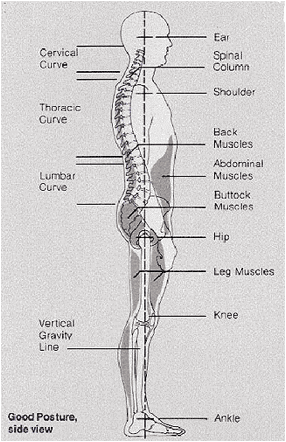
I speak a lot on the fact that there is poor correlation between bad posture and future incidents of pain. There are too many individuals out there walking with forward heads and shoulders but no discomfort and vice versa.
Instead, we've linked lack of variety in posture closer to pain. Good or bad, spending too much time in a single position is not what the body craves, and this often is the route to muscular tension and discomfort. This is why it's recommended to take regular movement breaks while at work. It doesn't take much.
Stretching Does Not Make Unstable Joints Happy
Thank goodness, the fitness industry seems to be tapering off a bit from the whole mobilitycraze that it went through. But I digress, I still see numerous individuals trying to stretch and traction their shoulders to proper health.
No, I'm not saying that joint mobility isn't important. But fairly enough, we went through a bit of an epidemic of fitness buffs non-specifically stretching their joints to the point of laxity with bands. Shoulders often hurt because they're, in simple terms, too loose. And stretching something in this condition will not improve the situation.
Warm Up, But Not Just Your Rotator Cuffs
So we turn to strengthening and warming up. Many individuals think that the rotator cuff muscles are the end-all for shoulder health. After all, their function is to stabilize the head of the humerus (the ball) in the socket.
However, what we don't always realize is that rotator cuff muscles are often simply overworked. Proper strength to control the movement of the shoulder blade is vital to shoulder health, so warming up and exercising the ability to protract, retract, and glide the scapula is key.
Your Upper Traps Are Not Your Only Traps
The upper traps seem to be the bane of many people's existence. The stress tension collects there, they take over other muscles' jobs, and the pain can be excruciating. And stretching often doesn't seem to have an effect.
Well, we know that muscle tightness is neurological. Sometimes, a muscle will present as tight because its opposing muscle is weak. The lower traps oppose the upper in part of their function, with the middle traps assisting the two. I frequently find these middle and lower traps weak in clients who complain of upper shoulder tightness, and so this is an important area to keep in mind.
Keep That Neck Strong
The muscles at the front of your neck are important for maintaining stability and control of that area of the spine. These are also one of the muscle groups that commonly become weak throughout our sedentary lifestyles.
I had to insert this somewhere.
Drawing your chin in like a drawer (or the double chin position) contracts those deep neck flexors at the front. Having these guys strong will prevent the neck muscles in the back or others from the shoulder from tensing up to try and create that stability on their own.
Subscribe
Do you like the content that you're reading? Sign up to receive the weekly blog update from Cain Exercise Rehab directly to your email!
I've already spoken at length in the past of the importance of keeping your shoulder stabilizers healthy and methods of doing so. We're being neglectful if we think that simply working the delts, pecs, bi's and tri's are all that are needed. However, while you shouldn't simply isolate the large muscles, doing similar isolation of the smaller ones as well are typically not going to be enough to keep your shoulder optimally functional either.
A common training/maintenance error I see is, while many people are mindful when it comes to warming up and strengthening their stabilizers, there's a tendency to still remain in isolated ranges of motion. For instance, even if you're exercising your rotator cuff muscles on the daily, like so...
...is that properly teaching those muscles to be stable and functional in movements like this...
...or this?
Your shoulder doesn't remain in a lowered position with your elbow at your side, so why would you restrict your stability training to that one range? Individuals who need to recover from injury, train for performance, or even just maintain function for every day life need to be hitting their stability work from multiple angles from the shoulder being down at your side to being overhead.
The shoulder is a highly-mobile, multi-angle joint. If you have a range of motion available, make sure the musculature is conditioned to be supportive in each of those angles. You want to be able to keep using those things.
Subscribe to the Weekly Updates
Do you like the content that you're reading? Sign up to receive the weekly blog update from Cain Exercise Rehab directly to your email!
I've spoken to several people lately who have been very concerned with their "cross syndrome" and have sought my advice in correcting it.
For those not in the know, cross syndrome is a term coined by Vladimir Janda in the 80s for a series of muscular and postural imbalances. It signifies the criss-cross pattern of shortening and lengthening of muscles that results in postural imperfections, such as the classic forward shoulder position from tight upper traps and pecs combined with weak neck flexors and lower traps.
These cross patterns occur through both the upper and lower body as termed by Janda. Similar principles exist through the entire kinetic chain overall, not being isolated with just the aforementioned saggital (front and back) planes.
I take issue with the name "cross syndrome", though, as I find that it's regarded with more fear than it should. The term "syndrome" is mistaken by many individuals (usually ones that are self-researching for their own health or working in fitness) to be synonymous with "disease". This is absolutely not the case.
I wrote before about how textbook posture is an unrealistic achievement and a largely-unnecessary goal. These cross patterns (as I prefer to call them) are often correlated to injury, yes, but not causative to them.
Many, many people will walk around with forward heads and rounded T-spines their entire lives and never experience shoulder pain. Anterior pelvic tilt does not automatically signify lower back pain. We need to not fear these postural imperfections and think that they always need to be corrected for.
Obviously, these patterns are something that we pay attention to if there is pain, because they provide the rehab practitioner a good place to start in terms of relieving the symptoms and the mechanics that caused the injury. In absence of a symptomatic dysfunction, though, there's very little to gain by trying to address the "imbalance".
All in all, there's no real problem with wanting to train yourself to stand taller, but we shouldn't be concerned when we look sideways in a mirror and notice "upper cross syndrome". If it ain't broke, don't fix it. If it doesn't hurt, if it doesn't impede your performance or day-to-day activity, it's probably functional.
Subscribe to the Weekly Updates
Do you like the content that you're reading? Sign up to receive the weekly blog update from Cain Exercise Rehab directly to your email!
Spring and summer are upon us and baseball season is here! Not only that, it's also home renovation and yard work season, all of which mean that your shoulders better be in good shape for all the work that they're in for.
If you're already hurting, then it's a good thing you're here to read on.
One of the most common things I see on clients who come in with shoulder injuries (especially the chronic, overuse ones) is the dominance of the upper trapezius muscle. Like many large, easy-to-engage muscles of the body, the upper traps like to act as the overbearing workaholic that does all the work for everyone else in the office. Pulling, lifting overhead, and more, these muscles have a tendency to initiate many large movements at the shoulder that smaller muscles are initially intended to take charge of. It's too the point that I (mostly) joke about just severing the nerve to the traps to see if can correct things that way.
This habitual dysfunction is a learned one, most likely from our desk job lives and sedentary behavior. (Being seated with arms elevated to high will shrug the shoulders up and result in increased tonicity of the traps.) Past that, poor education about body mechanics and constant reinforcement of using the incorrect muscles at home, at work, etc. grinds these habits in deep as we get used to using the largest and least-fatigueable of the shoulder muscles to do all the work. They're also muscles that are quick to spasm and guard in response to injury (such as whiplash). What's more, the popularity of weighted shrugs at the gym doesn't help, and removal of them from workout routines is, so often, one of the first instructions I give individuals in my office.
Why this is a problem is that this increased activity of the upper traps usually correlates to a weakness of the smaller scapular stabilizers (such as your serratus), both of which result in an excessive upward rotation of the shoulder blade and destabilization of the shoulder girdle.
While remembering that textbook perfect posture is not a realistic thing to have to worry about, if you do experience pain, these mechanics may be involved. Structures can be impinged from the incorrect shoulder positioning, you could have spasm through the upper traps causing neck pain, and you may be finding that your shoulder isn't handling well against impact and trauma.
With this in mind, you can see the importance of keeping those muscles beneath and below the shoulder blade strong and engaged while keeping the upper traps relaxed and ready as a complementary muscle to movement rather than the prime driver. And for crying out loud, stop shrugging at the gym; the only thing it helps is your ego.
Subscribe to the Weekly Updates
Do you like the content that you're reading? Sign up to receive the weekly blog update from Cain Exercise Rehab directly to your email!
I've got a case study for you, and it's a great example of why we need to be careful to not take mobility principles out of context. (Look at me, kicking that horse again. Get used to it.)
The Client
In this instance, I had an adult recreational hockey player in to see me for treatment. He had a history of shoulder injuries, some shoulder pain, and ongoing neck tension and headaches following his weekly hockey game. He exercises regularly, but doesn't often workout his upper body at the gym due to his lifestyle demands not requiring it.
In short, my plan of attack was to do some moderate soft-tissue release through his traps and neck, give him some self-mobility exercises to do before hockey, and some stabilization movements to strengthen his scapular and deep neck muscles. From the rehab side of the world, basic basic.
We tried this approach for two sessions in a row, a week apart. In both cases, my client felt great all week.
Oh wait, except for the two days after his weekly hockey games. Then the pain was like none other.
What Went Wrong?
I'll tell you what went wrong. My client was very responsive to the stabilization exercises and could feel himself standing taller and his shoulder sitting back much better all the way through. However, by increasing his shoulder and thoracic mobility (both through the treatment and through his home exercises), we inadvertently created instability that his muscles weren't yet ready to fully compensate for.
He described the pain after the second hockey game as "piercing straight from the back to the front" of his thorax. Essentially, after we freed up his joints and increased the movement happening through his thoracic spine and ribs, we created a need for the muscles in the area to work harder to maintain stability, Unfortunately, the strength and endurance in those muscles weren't yet there, and pain resulted for the days after the demand was placed upon them.
So after puzzling this one out, our third session was spent exclusively on strengthening exercises. We purposely avoided doing any hands-on soft-tissue release or joint mobilizations (aside from his self-mobility drills) to try and create a better foundation for stability first. After that treatment, he went to his hockey game and reported, finally, a relief in pain in the days following.
The Takeaway
This is a great reminder to be cautious with the amount of mobility and soft-tissue release that we're providing to our clients (whether you're an Athletic Therapist, a chiropractor, or personal trainer) or even to yourself. Rapidly releasing muscles and freeing up joints does not automatically translate to good health. It must be balanced with proper strengthening to allow the muscle to compensate for the increase joint movement, and those muscles will continue to need further conditioning in order to endure any extended workload demands. Even the best of us will still overshoot when it comes to these principles, but all's good as long as we can take care to reevaluate and not try to maximize range of motion in too short of time.
I was working at the gym tonight, doing my last-minute tidy, and, as is usual these days, had to untie all of our bands from their apparent homes attached to squat racks and cable machines. Not that there are very many of them left. We seem to be going through a lot of them in the past year or so. Do you know why?
"Mobility!"
One of the most seemingly trendy exercises to do these days is to use resistance bands to stretch and mobilize. Unfortunately, (or fortunately, for fitness equipment manufacturers), this means a decreased shelf-life for all the bands in your gym due to consistently being stretched to their maximum elastic length.
But, I'm an open-minded person. Maybe there's some merit to stretching with bands as opposed to other things. Absolutely, I've found some use with joint glides using bands (in the therapeutic setting), but for stretching itself, this is different. After my gym shift, I popped into my clinic to experiment in private.
The Verdict
Ok, mobility peeps. You may not be happy, but, as I concluded, the line of pull for stretching your lats and rhomboids using a band:
...was functionally no different than this:
Gasp!
In fact, using the pillar (or doorway, squat rack, pole, or anything else), actually gave me a better stretch. If you're wondering why, it's because the pillar doesn't stretch as well...like the band does. There's a reason everyone has to take their resistance bands to their end ranges - because that's the point where the band stops stretching. Doesn't it make sense to use something that just won't stretch in the first place for the assistance?
But Wait!
Well, maybe the gentle stretch of using the band is better, because those gentle pulses into the stretch help the muscle relax more.
Except no. Muscle spindles don't work like that. In order for the nerves in your muscles to allow the muscle to relax in a lengthened position, they must be overridden with consistent lengthening, not intermittent.
What About Training Overhead Range Of Motion?
Ok, I'll concede a bit here. Bands could be used to pulse through shoulder flexion and increase range of motion for overhead work. However, I'm still not a fan. With the band remaining uncontrolled in the lateral plane (moving side-to-side), you're essentially tractioning your shoulders at random angles, which could work out fine, or it could aggravate that old shoulder injury from football ten years ago.
Instead, here's my favourite exercise for shoulder flexion (and t-spine extension) done safely and controlled, via Eric Cressey.
Have I Missed Something?
Again, I'm open-minded. After experimenting, I went home and ran some Google searches on band stretching and mobilization to see if there was just something I was missing or doing wrong. Unfortunately, I couldn't find any source that cited the physiological benefit of bands over stable structures for assisted stretching. The best support for it was Kelly Starrett's videos, but even he seems to prefer the method, to my understanding, for the versatility of stretching different ranges rather than for a "better" stretch itself.
Yet, I do still invite the enthusiasts out there to challenge me on why we should be using these methods (besides just looking cool), and I'll absolutely listen. To this point, however, I remain unconvinced.
I posted before about a shoulder case study and some details about stability of the joint before, but here's some more day-to-day gym rat stuff for you all to chew on.
I work at what's known as the body-building gym of my town. Wherever you have heavy lifters, you have people with shoulder injuries, and thus there are the few of those trying to do what they can to take care of their shoulder health. There's a lot of common error when I look at lifters getting their shoulders warmed up, though, so here I am science-ing them to correction.
Firstly, let's talk about the rotator cuff. These four muscles are constantly being bogged down by injury, whether it's tendinosis, muscle tears, or impingement. The first error I run into are the people who think that simply keeping your rotators strong is the key to good shoulder health. However, most of the time when we have chronic shoulder injuries, it is not usually due to the rotator cuff being weak. In fact, even if the rotator cuff has an overuse injury itself, it is almost always as a result of weakness elsewhere around the shoulder girdle which is forcing the rotator muscles to overcompensate or causing other structures to restrict it. Most of the time, shoulder rehab programs are going to require more scapular strengthening, using muscles such as the serratus anterior in order to stabilize the shoulder blade and relieve the workload of the rotators. Here's one fairly basic warm-up exercise you can use to hit the proper muscle groups.
For something a bit more complex as you get stronger, I'll refer to one of the most well-known "shoulder guys", Eric Cressey.
Does this mean we should ignore the rotator cuff group in that case? Nope. They still need to remain strong enough for day-to-day work, especially if you're working overhead a lot. (Throwers and painters alike.) As well, if you're a traditional weightlifter who isolates your movements a lot, you still need to make up for the lack of use your rotator cuffs are getting while you do lifts such as bench or machine press. Bringing it back to Cressey, he recommends four days per week for his baseball throwers, while the average Joe will benefit from even 1-2 times per week for three sets.
So now that we've determined that you do still get to do rotator exercises, how do we do them? Firstly, here's what not to do. The most common incorrect method I see is the standing dumbbell variation...
So wrong that it hurts. Probably her more than me though.
The problem here is that if you think about the angle of gravity with this exercise, this doesn't hit your rotators at all. With the downward pull at your shoulder from gravity, the only muscles that are actually working are your deltoids and traps. A line of pull to give resistance to the rotational movement is absent. If you're going to use dumbbells to hit the correct muscle group, you're going to have to lay down on a bench, first on your back and then on your side to hit the internal and external rotators, respectively. Standing with your arms at 90 degrees for external rotation works as well, but you'll still need to reposition to the bench for the internals.
The easier solution for your exercise is to use either a band or cable with a horizontal line of pull. I'll make one tweak to usual way of doing it, however. While performing your internal and external rotation, squeeze a towel between your elbow and body. The first reason for this is that it puts your shoulder girdle into "scapular plane", which is essentially the angle that will be the most stable and ideal for the shoulder to be moving in. Secondly, having the towel to hold on to ensures that you don't make the common cheat and allow the arm to lift away from the body, again creating compensation using your delts.
To conclude, if you want to keep your shoulders strong and stable in the gym, exercise the rotators using a band and don't neglect your scapular muscles in your upper back. Yes, we all want to get over to the bench press as quickly as possible, but proper prep before your workout will save you more time out of the rehab clinic later.
Photographed rather than filmed, because your computer volume does not go low enough.
The frustration was getting to her.
Connie is a dedicated gym-goer with a 6-day/week workout routine. She’s a personal trainer and yoga instructor, follows her own regiment religiously, never misses a day, and embodies the image that many women would kill for.
Connie’s struggle of late has been difficulty in getting better at wide-grip pull-ups. She added assisted pull-ups to her weekly back and bicep workout, trying to see improvement.
The result: FAIL! After four months, she was still stuck maxing out at four pull-ups, assisted! This raises a flag, as we can assume she has a thorough understanding of muscular training adaptation to be able to structure her workouts and see the desired result.
This tells us there’s a glaring discrepancy somewhere in her body mechanics preventing her from achieving her goal which needs to be addressed, much like I'll almost always see when treating clients for musculoskeletal injuries.
After hearing her complaints about the lack of progress being made, I took notice of her shoulder blades. If you saw them at the time, you would have seen her scapulae winging out during any shoulder retraction, cueing us to some kind of bio-mechanical error that needed to be addressed.
No, these wings will not aid in flight.
Shoulder Mechanics
With a working knowledge of anatomy and physiology, we know that the scapular muscles (most significantly the serratus anterior, but consisting of several other muscles of the shoulder girdle) are meant to stabilize the scapulothoracic joint. These muscles should be active in maintaining the position of the scapula against the rib cage during posture and to control its movement during ranges of motion at the shoulder.
When those muscles get weak, we see this winging, causing a change in the total angle of the shoulder girdle and improper recruitment of larger muscles which are now attempting to compensate for the lack of stability.
If that sounds complicated, just know that if scapular muscles get weak, big shoulder muscles get overworked, shoulder strength and health deteriorate.
Pictured: Large, prime movers - Left
Stabilizers - Right
I see this problem arise quite often in individuals who follow traditional weight-lifting programs, whether it’s team-sport athletes, body-builders, or average-Joe’s. What’s happening is that the nature of your traditional weight-lifting routine (isolated exercises, weight-machines, supported shoulders against benches) remove the use of the small, stabilizing muscles from the equation.
High end body-builders who receive proper training subvert part of this problem by properly adding isolation of those smaller muscles into their routines, effectively strengthening the scapular stabilizers and preventing the winging of the shoulder blade that would ruin the aesthetic appearance they need.
However, these individuals are still prone to chronic shoulder injuries such as rotator cuff tendinopathies and biceps tendon impingement. Why is that? It’s because the strength of those muscles may be well-trained, but the stability is still lacking. (Note: This is a tendency, not a rule. Don’t hate.)
We see errors quite often in the clinical setting when it comes to retraining muscular stability. In much the same way traditional weight lifters will train themselves, a therapist can easily get caught up in prescribing basic isolation exercises in either excessive amount or for too much time.
True, if there is severe weakness and inactivation of a particular muscle, then of course it needs to be targeted specifically at the start of a rehab plan. But as we progress an individual to the more advance stages of returning to function, synergistic muscular training is key.
We can’t expect proper shoulder mechanics (which requires stability provided from multiple smaller muscles working together) to arise from training each muscle separately and isolated through range of motion.
Exercise Recommendations
After realizing the large discrepancy in shoulder stability, I gave Connie two very simple exercises to do.
The first one was a scapular push. This one is hard to explain in written words, so take a look at the video below. This exercise was to be done daily for two sets of 10 reps per side.
The second exercise, the T-curl is an isolation one (as I mentioned is still often important as a supplement) for serratus anterior, one of the major stabilizers. This one was prescribed for 2-3 sets of 10 reps on Connie’s “pull” day at the gym.
Keeping the upper arm parallel to the floor and the entire limb in the frontal place, the cable is curled in with the palm flipping between every rep.
Connie did these two exercises, as instructed, for 8 weeks, without modification. After four months, pre-intervention, of Connie barely being able to muster out four assisted pull-ups, she is now pushing towards ten reps, unassisted.
The results speak for themselves.
Big lats and biceps are only part of the equation; you need to take care of the small stuff as well. It’s important to not neglect the prime movers, but when attempting to retrain healthy movement, the foundational support needs to be considered first when prescribing exercise.
Exercise rehab like this is clearly vital in the clinical setting. However in Connie’s case, her condition was not yet pathological and causing pain. In the case of clinical clients, we’ll need a bit more intervention on the therapist’s side.
With individuals who have such severe scapular weakness, you’ll also typically find significant spasm and adhesion in those same muscles due to the body attempting to create stability any way it can. It’s also important to look at the antagonistic muscles to what we’re focusing on; in this example that would mean taking some time to work through the pectoralis muscles that, combined with the weak upper back, will likely contribute to a rounder shoulder and t-spine posture. Connie is going to continue her training using these interventions, possibly with some further modification, and I can confidently predict that her progress will not plateau any time soon. Luckily, we were able to target her weaknesses before they became pathological issues, but this won’t always be the case. However, whether or not your treatments in the clinic start with basic exercises or even manual treatments alone to begin with, the progression that I did with Connie is an excellent example of late-stage rehab that we can use to get our clients above and beyond their pre-injury state.