Showing posts with label back health. Show all posts

Tuesday, 12 March 2019

What Causes Back Pain?

4 out of 5 Canadians experience back pain at some point in their lives, most commonly to individuals between the age of 30 and 50.

While there are many physical culprits that we can identify in cases of back pain - sprains, strains, discs, etc. - the biggest culprit that causes pain to flare up are our habits. In sport, at work, during life, certain ways that we move (or don't move) can be the determining factor pain-onset, whether x-rays show structural defects or not.

Idle Posture

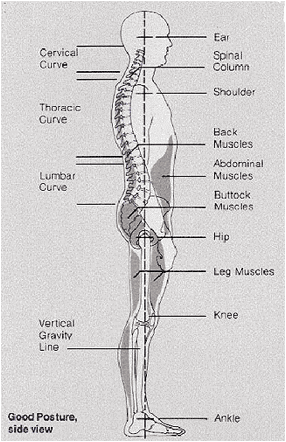
Allow me to be clear in that "bad posture" does not cause back pain. New studies now find that poor posture, in fact, correlates quite poorly to future pain.

I read an excellent quote, however, stating this:

"The only bad posture is the one that we spend too much time in."


In reality, the fact that we sit or stand a certain way does not result in us experiencing pain. Rather, it's the fact that we hold those idle positions for too long. The body craves movements, and so delivering on this can have great results. Regular breaks from sitting at work, for instance, has excellent benefits on preventing pain.

Solution: Move more.

Repetitive Activities

As another clarification, repetition, inherently, is not bad for you. Our hips move in a forward-and-backward motion to allow us to walk all day, every day, and you don't see the majority of the walking population collapsing due to overuse hip injuries.

The problems arise when the body is not properly conditioned for the particular movement being repeated.

Many runners perform fine without injury occurrence, but the one's that are not properly trained to drive strength from their hips will encounter problems.


As a non-sport example, many housekeepers won't be bothered by the amount of windows they clean. Just the ones that overuse their wrists and elbows instead of utilizing the large muscles from their shoulders.

In short, the body is able to handle just about any repetitive activity. However, depending on the volume and frequency of those movements, a certain level of strength and endurance may be needed.

Solution: Move differently.

Subscribe

Do you like the content that you're reading? Sign up to receive the weekly blog update from Cain Exercise Rehab directly to your email!

Click Here!

Book Now

In the Victoria area and interested in booking an appointment with Cain Exercise Rehab? Follow the link below to book online!

Click Here!

Tuesday, 27 March 2018

My Big 3 On Back Pain

In Canada, 1 in 5 individuals struggle with chronic lower back pain and, tragically, this condition is mistreated on a worldwide scale.

This being said, one of the most important tools we have in addressing this crisis is not in the techniques and machines at our disposal; rather, it's the knowledge and education on the nature of back pain itself. Here is a list of need-to-knows for your pain.


Imaging Often Gives Inaccurate Pain Diagnoses

A lot of people are sent straight to the x-ray lab upon seeing the doctor about their back pain. Unfortunately, the results of imaging often do not reflect the actual nature of their problem and can sometimes even make the problem worse.


Asymptomatic individuals have a high rate of having abnormal findings on their scans. This suggests that the actual cause of pain isn't necessarily the physical structure of the spine, shifting our need to focus on something other than just decompression and surgeries. Which leads us to...

Your Nervous System Is The Likely Culprit

Tissue heals. Muscle repairs. Bones regrow. But pain does not always go away, even after the body itself has otherwise bounced back.

The nervous system, itself, can runaway from us, releasing and propagating nerve signals once the initial injury or stimulus triggers them. And no, this does not mean that the pain is in your head; it means that the nervous system, while being integrated with the body's other systems, is still it's own entity that must be treated as well.


Flexibility Probably Isn't The Key

A lot of people assume that their persistent back pain is caused by "just being tight" and attempt to resolve the problem through an aggressive stretching routine. True, while yoga is suggested to offer some benefits in relieving back pain, the actual relationship between lack of flexibility and pain is comparable to that of the x-ray findings.

This is especially good to know for when it comes to those who attempt to fix their pain through aggressive self-massage. Sometimes, a lack of flexibility is there for a reason, and releasing a muscle too much could actually result in more pain.


This might tell us that the yoga benefits are more to do with the strength and postural control than anything regarding muscle lengthening, giving us a place to productively start looking for solutions.

Subscribe

Do you like the content that you're reading? Sign up to receive the weekly blog update from Cain Exercise Rehab directly to your email!

Click Here!

Book Now

In the Victoria area and interested in booking an appointment with Cain Exercise Rehab? Follow the link below to book online!

Click Here!

Tuesday, 30 January 2018

Life Doesn't Mirror Gym Movements (And Doesn't Have To)

No, I'm not telling you that the gym is bad and that you should stop going. There are many fantastic reasons why the gym is awesome.


However, there's a certain phenomenon among many of my clients that I'm noticing. Fear of movement.

The best example is the rounded-spine position. On one hand, many individuals who experience back pain are told by doctors, therapists, and more to absolutely avoid bending down and rounding their backs; that doing so will result in more pain. Having this fear of that movement instilled, however, does little to remove their pain, as these positions are, to say the least, inevitable. As a result, the nervous system, essentially, becomes primed and ready to guard against those movements, causing pain in those ranges and positions when pain wouldn't normally be a necessary response in that case. 

We call this kinesiophobia, the fear of movement due to pain which actually works to prolong pain and disability.


Here's the surprising thing. Active and healthy individuals experience this too! I've also seen this in very disciplined gym-goers who, for all intents and purposes, have nothing mechanical going on to suggest that they should be in pain. However, due to the immense emphasis on "good form" that active and athletic individuals may be bombarded with, I've been witness to the exact same avoidance-triggered pain. These are clients who are under the impression that it's necessary to square-up and keep a neutral spine curve every time that they so much as bend down to tie their shoes. And again, this belief that any other type of position is harmful is so strong that, just the same, they experience guarding and pain. Even so-called functional training isn't devoid of instilling these messages.

The takeaway from this is that the body has very natural movement patterns that it likes to use that don't necessarily reflect the strict and controlled form of the gym. Absolutely, if you're at the squat rack, moving in a single-plane only, and are loaded up with multiple plates per side, then you should definitely be observing "proper form". However, whether you're an active or inactive individual with or without formal training, the body is built for free and fluid movement. Don't let anyone, including Instagram personalities, magazines, or even doctors to tell you that dropping form as you live your life is a dangerous thing.

Credit: Greg Lehman


Subscribe

Do you like the content that you're reading? Sign up to receive the weekly blog update from Cain Exercise Rehab directly to your email!

Click Here!

Book Now

In the Victoria area and interested in booking an appointment with Cain Exercise Rehab? Follow the link below to book online!

Click Here!

Tuesday, 23 January 2018

Is Running Bad For Your Joints?

You'll be hearing me celebrate the return of running season for the next little while. Running is a fantastic exercise and sport, and I'm more than happy when I see both experienced and brand new runners partaking. However, is running a healthy activity?


It has generally been the common consensus that running is bad for your joints, whether it be for your knees, your hips, or back. Thus, it's often the reason (or excuse) for many people to not partake in any running. It makes sense; too much impact on the joints could totally cause some arthritic development or degeneration in the spine. As we understand it, this is basically the definition of how osteoarthritis onsets, right?

The research journal search was actually extremely easy here. As I was able to find out, between both old and new studies, long-term studies, and cross-analyses, running was almost always found to be unrelated to any development of osteoarthritis in the knee, hip, and spine. At the worst, some studies suggested it to be merely inconclusive.


In fact, one brand new piece of research even found that, as far as intervertebral discs go, running actually promoted more strength and better disc health as opposed to contributing to degeneration!

So what's going on? What actually causes arthritis? Well, recent skeletal examinations are now suggesting that osteoarthritis development has more to do with a lack of physical activity rather than too much of any particular type. This was strengthened by the fact that degenerative joints correlate highly with the morbid obesity seen in many modern-day skeletons.

Furthermore, there may even be mechanisms that actually protect runners from degenerative changes from their spot. While the overall impact and force going through the joints is higher during a running gait, there may be some evidence suggesting that the decreased contact time with the ground actually works to counteract any damaging effects.

All this being said, no, running is not the joint-destroying, pain-inducing activity that many out there believe it is, and there's even the possibility of being a runner if you already do have arthritis. Keep in mind, running, like ANY other activity, can cause injury, whether it be from an accident, poor conditioning, or training error, so don't forget the importance of proper training.


Subscribe

Do you like the content that you're reading? Sign up to receive the weekly blog update from Cain Exercise Rehab directly to your email!

Click Here!

Book Now

In the Victoria area and interested in booking an appointment with Cain Exercise Rehab? Follow the link below to book online!

Click Here!

Sunday, 15 October 2017

Happy World Spine Day

October 16 is World Spine Day! Today, organizations and people, worldwide, join together to raise awareness of spinal health and illness.


Listed below is a compilation of back health-related articles written both by myself as well as outside sources. They're all very informative and easy to read, so please take a look and empower yourself with some knowledge!

Cain Exercise Rehab Posts

One of my earliest posts outlining the basic functions of the core as an "anti-movement" system and the reason why the medical community is vigourously recommending against sit-ups.

It's common for weightlifters to fit their ab workout at the tail-end of the session following training another area. However, here's my reasoning on why it's beneficial - for the long-term and for the workout - to do a few sets of core exercises before the rest of the workout instead.

A short article (with video) on how to train your core to stabilize during the much-neglected range of hip-extension for when you walk or run.

Weight lifting belts are a crucial element for weightlifters who are pushing those heavy one-rep maxes or doing fatigue-sets. However, what happens when a person becomes over-reliant on the support?

Traction is an extremely popular alternative treatment for back pain, but here's a short discussion on whether or not there are sound benefits for the long term.

Planks are what the media is currently pumping out as the solution for spinal health and tight abs. However, this is more out of the simplicity of the exercise for the purpose of quick explanation. In reality, planks are only going to get you so far.

This may be one of the most important articles to read! If you have had imaging that revealed degeneration or other concerning problems in your back, click this link!

Source

External Sources

You've probably seen some variation of this headline in the past. However, rather than fear-mongering for likes, this writer dug up the research debunking the claims of "text neck".

Dr. Stuart McGill discusses many popular forms of back pain treatment and why they're likely ineffective - or even counterproductive! Don't worry, he also gives solutions to the problem.

An investigative journalist scours the research to come to her own conclusions on what is actually proven to be beneficial for the spine and what is not.

Spinal fusion is still commonly prescribed by doctors much too early in the process of finding a solution for back pain. More often than not, it only results in more problems down the road.

One more article from Stuart McGill as he debunks the most common back pain myths and offers helpful alternatives to address your pain and injuries.


Subscribe to the Weekly Updates

Do you like the content that you're reading? Sign up to receive the weekly blog update from Cain Exercise Rehab directly to your email!

Tuesday, 12 September 2017

Plantar Fasciitis (And The Nerves That Imitate It)

I thought that this would be a good post to make, as I've now encountered a handful of clients with this issue. Individuals have come to see me with complaints about plantar fasciitis that has been persistent to any amount of stretching or foot massage.


In these instances, my typical process was to assess the injury but have difficulty replicating their pain using any ranges of motion or muscle testing at the foot, ankle, or knee. Pain with pressure was common, however.

After attempting to treat the plantar fascia with no benefit, I had to flip switches and try something different. Having some experience with this before (and with the wonderful handiness of the internet) I zoned in on testing a couple nerves instead.


Most people assume that nerve pains follows the trend of always beginning centrally near the spine and extending down the length of the limb. However, it is only a trend, not a rule. If entrapment of the nerve occurs further than the spine or in several, less severe areas separately, then the symptoms can absolutely manifest at only the end of the limb, like in these "plantar fasciitis" cases.


Both the sciatic and the saphenous nerves have the potential to cause plantar pain that many people may think to be fascial. (Both can be dull, diffuse, or burning pain.) However, upon proper testing where we put the nerve itself on stretch, we were able to determine the root of the cause. Without fail, after treating these clients up at their hips or back instead, we were able to relieve the pain.


Just a good example that therapy and rehab isn't as easy as chasing the pain. Often, you have to go quite a ways up the chain in order to find the cause. In these cases, finding that cause can be a hard thing for clinicians to do, considering that protocol wouldn't normally involve having to rule out joints as high as the spine in cases of foot pain. However, therapist or client, it's important to keep in mind that the body works as whole.

Subscribe to the Weekly Updates

Do you like the content that you're reading? Sign up to receive the weekly blog update from Cain Exercise Rehab directly to your email!

Tuesday, 15 August 2017

Pain Psychology - Avoidance Habits

I've been clear on my stance that the sooner someone seeks rehab for their pain, whether it's an acute injury or an overuse condition, the quicker and easier the recovery will be. There are a multitude of reasons for this, one of which is avoidance habits. 

Consider the scenario where an individual suffers a low-back strain while working. Instead of doing something about it right away, he continues to work through it. As it becomes worse during the week, he begins to modify his work mechanics. After a while, the pain becomes such that he drops to light-duty tasks to try and allow himself to rest. Still not seeking help, he starts avoiding any heavy lifting at home as well. This entire time, his body becomes more and more deconditioned due to lack of use, propelling the amount of pain he's experiencing. Soon enough, the individual no longer feels comfortable attempting any work, now expecting pain should he try. 


These types of cases are extremely common, with essentially every person experiencing long-term pain developing habits to help them avoid that pain that they live in fear of. As the extremity of these habits progresses with the severity of issue, not only does the affected (and protected) area become weaker, but also does the individual become more unwilling to confront that pain in order to finally take action on it.

My knee hurts. I'm gonna stop adulting from now on.

Furthermore, it's likely that this conscious guarding of the body against pain has even more psychological implications that propagate pain. For instance, hyper-awareness of information regarding their pain is likely to exacerbate an individual's perception of it.

This ties in closely with the pain-identity occurrence that I wrote on before, in that avoidance habits quickly lead to development of that chronic state if being unable or even unwilling to return to a healthier state.

Like before, careful imagery and visualization of an improved quality of life is important, as it helps to reestablish the belief that recovery is attainable. Goal-setting, as usual, provides the framework to create a realistic view on the process. 

Clients should also be encouraged to gradually - and controllably - return to movements and activities. Exposure to "acceptable" levels of pain in this way will assist in helping those people in moving past their fear it and more willing to confront it to recover without damaging them more in the interim.


Protection methods are often necessary in early stages of injury, but preventing them from turning into avoidance habits is something that therapists need to be attentive toward. Individuals need to be encouraged to return to their activities after they heal, not to completely fear those activities and allow it to stonewall their recovery. 


This topic was written with consult and collaboration with Alison Quinlan, a Sports Behavioural Consultant in Victoria, BC who is also pursuing continued education in dietetics. Follow her on Twitter and visit her website and blog to see some of her own authored articles. 


Subscribe to the Weekly Updates

Do you like the content that you're reading? Sign up to receive the weekly blog update from Cain Exercise Rehab directly to your email!

Tuesday, 1 August 2017

Overcoming Pain - Perception of Control

There are many psychological facets that result from or contribute to pain, one such as I described in last week's post. It's important to remember, though, that no trait is independent of one another; they'll occur concurrently and are interrelated. That being said, I'll continue to break it down to help both my readers and myself understand the psychology of pain better in order to overcome it.


After a large sample of patients were interviewed, another of one the biggest predictors of chronic pain that was found was poor perception of control.

In a nutshell, when individuals are in pain, (even if it's only acute pain) and they don't have high self-confidence in their ability to recover from it, the result can be that those misconceptions may come true. Why is this?

To quote the above study, perception of low personal control can "lead to passivity, inactivity, reduction or cessation of coping attempts, avoidance of specific behaviours and poor adherence with advice". It may sound like a deplorable attitude toward one's own body and wellbeing, but if you think about it, it makes sense. If you were a mechanic and were told by your boss to do everything you could to repair a car while every inherent ounce of your gut told you that it couldn't be done, would you still put in the same amount of effort in the attempt?

This fact isn't helped by the fact that so many individuals go through the rungs of  other medical professionals who use language that enforces these beliefs!
  • "You'll have this for the rest of your life."
  • "It's only going to get worse with time."
  • "You have the knees of a 70 year old."
  • "You need to see me every week if you want to keep walking."
"My elbow hurts."
"We'll have to cut it off."
No wonder why so many people plateau in their rehab! Everyone is telling them they can't do it and bringing them down!

As an Athletic Therapist, specializing in exercise rehab, I can provide one of the best methods to help my clients boost their confidence in their recovery. What better way is there to increase their perception of control over their health than by giving them the tools that allow them to do the work themselves? (In contrast, if an individual only sees a clinician that massages or adjusts them without any other intervention, that puts all the control of their recovery into that clinicians hands.)


To help the matter, I make very sure to educate my clients on what every single exercise that I prescribe is doing; which muscle it's helping, what this stretch will do, how it replicates their daily activities. Clients need to know exactly how much power they have in propelling their own recovery. They want to know how their bodies are working. They need to hear less about what their therapist can do for them and more what THEY can do for them.


At the same time, I'm careful with my language. Essentially, it's important to put an optimistic spin on things in order to maintain a positive outlook and efficacy.
  • "This muscle could be stronger," instead of, "This muscle is weak."
  • "We need to get your hip moving better," instead of, "Your hip keeps getting stuck.
  • "You'll feel better the more you do your exercises," instead of, "If you don't do your exercises, you'll be in more pain."
See what I did there?


This topic was written with consult and collaboration with Alison Quinlan, a Sports Behavioural Consultant in Victoria, BC who is also pursuing continued education in dietetics. Follow her on Twitter and visit her website and blog to see some of her own authored articles. 


Subscribe to the Weekly Updates

Do you like the content that you're reading? Sign up to receive the weekly blog update from Cain Exercise Rehab directly to your email!

Tuesday, 18 July 2017

Specific Adaptations to Imposed Demands

There was one principle that was commonly reiterated to us all throughout school. 

SAID: Specific Adaptations to Imposed Demands

Whether it's for rehabilitation or for fitness, this is a very important thing to note about the body's reactions and adaptations to the stresses we place upon it. Beneficial changes cannot and will not occur if we don't give them a reason to happen.

So, in the same way that you won't gain muscular size if you don't work out, you also can't expect tissue to properly heal following injury if we don't exercise it in the manner that we need it to function.

Why aren't I in shape?
Essentially, you use it or lose it. I can't tell you how many times I've heard potential clients decline starting rehab in their acute phase of injury because they think that they need to rest and wait first for partial healing to occur on its own. This is especially rampant among elderly demographics who simply feel unsafe attempting any sort of exercise too close to their injury.

It doesn't always have to come to this!

Unfortunately, young or old, too much rest is more detrimental than anything. Immobilizing injured tissue results in it healing in a way that typically doesn't allow for optimal return to activity, as the tissue was not stressed with any of the demands that replicate it's intended function.

I cringe every time someone tells me that their doctor recommended nothing but bedrest; something that is still painfully common. Inversely, when an injury occurs on an athlete whose team I work with, I get to witness the increased speed that they bounce back completely from injury. Just by jumping on top of exercise and range of motion immediately during the acute phase, we're able to seriously cut down on their recovery time.

I'm being real; I'm not expecting you to box jump and power clean directly after blowing your ACL. There's always some sort of movement that is possible, though, and something is always better than nothing.


Subscribe to the Weekly Updates

Do you like the content that you're reading? Sign up to receive the weekly blog update from Cain Exercise Rehab directly to your email!


Tuesday, 11 July 2017

Cross Syndrome Is Not A Disease

I've spoken to several people lately who have been very concerned with their "cross syndrome" and have sought my advice in correcting it.

For those not in the know, cross syndrome is a term coined by Vladimir Janda in the 80s for a series of muscular and postural imbalances. It signifies the criss-cross pattern of shortening and lengthening of muscles that results in postural imperfections, such as the classic forward shoulder position from tight upper traps and pecs combined with weak neck flexors and lower traps.


These cross patterns occur through both the upper and lower body as termed by Janda. Similar principles exist through the entire kinetic chain overall, not being isolated with just the aforementioned saggital (front and back) planes.

I take issue with the name "cross syndrome", though, as I find that it's regarded with more fear than it should. The term "syndrome" is mistaken by many individuals (usually ones that are self-researching for their own health or working in fitness) to be synonymous with "disease". This is absolutely not the case.

I wrote before about how textbook posture is an unrealistic achievement and a largely-unnecessary goal. These cross patterns (as I prefer to call them) are often correlated to injury, yes, but not causative to them.


Many, many people will walk around with forward heads and rounded T-spines their entire lives and never experience shoulder pain. Anterior pelvic tilt does not automatically signify lower back pain. We need to not fear these postural imperfections and think that they always need to be corrected for.

Obviously, these patterns are something that we pay attention to if there is pain, because they provide the rehab practitioner a good place to start in terms of relieving the symptoms and the mechanics that caused the injury. In absence of a symptomatic dysfunction, though, there's very little to gain by trying to address the "imbalance".

All in all, there's no real problem with wanting to train yourself to stand taller, but we shouldn't be concerned when we look sideways in a mirror and notice "upper cross syndrome". If it ain't broke, don't fix it. If it doesn't hurt, if it doesn't impede your performance or day-to-day activity, it's probably functional.


Subscribe to the Weekly Updates

Do you like the content that you're reading? Sign up to receive the weekly blog update from Cain Exercise Rehab directly to your email!


Tuesday, 27 June 2017

Self-Testing Your Hip Mobility

I did a post a while back regarding the importance of hip mobility for spinal health. I discussed the implications of lumbar spine compensations should the hips not be able to flex and extend properly.

BU T - how common is a lack of these ranges in the hips, really? In that article, I noted that most losses of hip flexion are purely soft-tissue restriction (those darn't hamstrings) while compensations of the spine during extension are likely just due to instability in the core.

In my experience, I've seen very few clients who have a deficit in hip mobility at the joint-level itself in flexion and extension, save for for traumatic accident victims, post-surgical clients, or the elderly.

This isn't to say that it doesn't happen. That being the case, however, considering how many people are aggressively trying to mobilize those ranges at the gym all the time, I'm here to show you some quick ways to self-assess whether you're one of the people who actually requires it. (Pro-tip: You're most likely not one of those people.)

Flexion


Lay down on the floor (not a squishy bed) on your back. Rotate your pelvis all the way forward and make a big gap between your low back and the floor (anterior rotation) and then rotate it back so that the lower back is flattened on the floor (posterior). Now, find the spot directly in between those two end-ranges, which will be your neutral position.

From here, you want to make sure that your hips don't leave that neutral position. Focusing on keeping the pelvis where it is, pull one knee at a time all the way into your chest.

You'll probably notice that you got your knee somewhere between 90 and 120 degrees from the floor. Surprise! You have optimally mobile hip flexion!

Extension


Self-testing your extension will follow a similar pattern. Standing this time, find the a doorway or pole that you can have half of your body up against. Standing with your back to it (one butt-cheek on, one off) find your neutral pelvis position again. Place a hand in the small of your back to ensure that the distance between your back and the surface stays consistent while you extend the free leg back behind you, stopping when you feel your back forced to extend.

An average distance is anything past 0 degrees and up to 30, so if you were able to make it any distance at all, then you're healthy!

My Point

What I'm getting at here is just a demonstration that true flexion and extension hypomobility issues within the joint itself are not common. If you can't flex your legs far, you likely have excessive hamstring tension (removed by the bent knee when we tested). If you're spine deforms in extension, you probably just have an unstable core that's unable to withstand the force generated by hip extension when done dynamically.

If any range in the hip joint is lacking, it's probably rotation, but I'm going to get to that in a future post.

With all that in mind, it's probably time to abandon the banded hip mobility workouts and just start addressing the soft-tissue again like back in the good ol' days.

Subscribe to the Weekly Updates

Do you like the content that you're reading? Sign up to receive the weekly blog update from Cain Exercise Rehab directly to your email!

Tuesday, 20 June 2017

Psychological Barriers of Recovery

Pain hurts..obviously. So when presented with a method of managing and removing that pain, it should be easy to do what needs to be done to comply. Experience, however, tells us that this is not the case.

We've seen it. The individuals who simply won't seek help despite being in chronic and excruciating pain. The ones who make their appointments but cancel the majority of them on a whim. Those who show up, but simply won't adhere to their exercise rehab plan enough in order to progress in their recovery.

I'm feeling to "blah" to go to my appointment today..

I often joke about the "fantasy client"; the one who always shows up on time and never misses a single day of their exercises. These clients are few and far in between.

Why is this? If there's a road to healing, why are are so many people reluctant to take it? Well, there are several psychological barriers to recovery, and it won't be possible to try and touch on them all. There are some common ones that I see in my practice, though.

One big one is a lack of client education regarding the condition and treatment; therefore, a lack of trust in the process for recovery. I find that many people, while seeking treatment, are almost just going through the motions due to consciously knowing that they have to try and get better, yet subconsciously having little faith in succeeding. I've seen many clinicians experience a downfall in this realm in that there is minimal communication on what's happening and how things - whether it's the body or the treatment - work, resulting in poor success rates in the rehab.

There's also those who would like to be pain-free again, but are weighed down by thoughts of unattainable (or at least perceived-so) situations about their lives and bodies which might make recovery seem like it has less meaning. What I mean by this, for example, could be an elderly lady who has back pain she'd like to be rid of but is less motivated because she still won't regain her 20 year old figure. The retired athlete who no longer has a competition goal to work toward. The spinal cord injury patient who can't expect to regain his full nerve function again.


As an Athletic Therapist, how do I work around these barriers? It's my job to help clients get better despite their other facets of life, not to try and fix their entire personal situations (which I couldn't do if I tried). Instead, it's important to help these individuals pave their own ways to success through over those hurdles.

My method isn't complicated. Education, obviously, is key. Client understanding of their injury is important in order to understand how the healing is going to work, and so I spend an ample amount of time making sure I explain exactly what is happening with the individual's body and what our treatment aims and mechanisms are. This is one of the most surefire ways to give clients faith in the process and maintain their perception of treatment efficacy.


Goal-setting, as well, is vitally important during the healing process. Sure, maybe the client isn't going to be training for professional hockey ever again, but maybe he'd like to aim for that biking trip with his son. That elderly lady may not regain her 25 year old figure, but how about a goal of walking (or running) that next city 10k race? Those long-term goals are help to re-perceptualize the process to help the short-term ones have more meaning.

As I said, it seems like a no-brainer that if you want to be rid of pain, it should be easy to adhere to the process; but that's in theory only. Often, people need help and guidance in order to increase their perceived efficacy of the treatment and to adjust their goals to something attainable, but still meaningful.

Health: It's not all in your head, but the head is sure part of it!

Subscribe to the Weekly Updates

Do you like the content that you're reading? Sign up to receive the weekly blog update from Cain Exercise Rehab directly to your email!

Tuesday, 23 May 2017

I'm Not Ready For Exercise

"I'm not quite ready for exercise rehab yet."

I've been told these words before. Potential clients are often seeking treatment elsewhere, are waiting for surgery, or are simply trying to find a working medication before commencing an exercise rehab program with the idea that they need to find alternative pain relief first before coming to see me.

Honestly, I understand where this is coming from. For many people who are unaccustomed to regular physical activity in the first place, the word "exercise" carries a certain stigma that creates nerves and anxiety - especially when a high amount of pain is currently present.

It's a social bias, really, and one that is likely propagated by media and pop culture. When people think "exercise", their heads often immediately go to Rocky montages, Arnold videos, and "hardcore" Youtube workout clips. Fairly enough, modern ideals tell us that exercise means heavy squats, deadlifts, and Olympic lifting, but this misconception may be impairing recovery for many individuals.

Ignore the grinding in your spine and give me 100 more!

I think it's obvious that I don't expect someone with debilitating back pain to be ok with being thrown into an intensive barbell workout routine. However, the idea of even basic exercises is intimidating to many people seeking pain relief, especially if those people are in severe chronic pain. When every movement hurts, how can they be expected to follow a strength program with a sets-and-reps scheme?

The thing to realize is that "exercise" does not necessarily mean big movements with heavy (or any) weights. As an Athletic Therapist, my job is to use exercise to retrain the body to manage pain. The fact that you're in a large amount of pain already does not condone not doing it; it means we modify the movement until it doesn't hurt. By not intervening into the the existing problem with exercise, how else is the body going to change its (potentially) pain-causing habits?

Often, with low-functioning clients, exercise won't even entail much movement at all. With many individuals, you'd be amazed at the progress made by some of the smallest muscles contractions; seated core bracing and diaphragm breathing to alleviate back pain, chin tucks and shoulder setting to stabilize the neck; even eye movements to help with whiplash migraines!

So no, I'll argue that no one should feel barred by exercise. (Certain bed-ridden and immobilized conditions being the exception, of course.) The right therapist will always be able to provide you with something at your level that you can do, regardless of that level being high or low. Your body is it's own best medicine.

Subscribe to the Weekly Updates

Do you like the content that you're reading? Sign up to receive the weekly blog update from Cain Exercise Rehab directly to your email!

Wednesday, 19 April 2017

Is Your Core Strong Enough For Your Squat?

A friend called me on Easter Sunday with a bit of an urgent need. He's a good friend, so I came into the office for the holiday. The issue? He threw out his back squatting.

This individual is a very strong, powerful weightlifter, but this wasn't the first occurrence of this type of injury. I had to give him a bit of a hard time, however, as I knew he hasn't been keeping his core conditioned for the heavy lifts he does. Unfortunately, he's far from being alone in this situation.

As I so commonly drone on about like a broken record, core strength is essential for activities of daily living and for keeping the spine healthy during weightlifting and sport. Truly enough, though, with careful attention to form, exercises such as squatting without a strong core is still possible. Especially with back squatting, with the bar sitting at the back of the body to focus the weight through the hips to make it easier to engage the more powerful lower-chain muscles, people tend to neglect the need for trunk stability. What's more, with the arms out to the side with the back squat, we are able to achieve activation of the lats which assist with spinal stability through their connection to the thoracolumbar fascia (which essentially covers the entirety of the lumbar spine).


However, switching to the front squat, with the weight lying to the front of the body and the forces threatening to deform the spine a bit more - and with the lat engagement removed - any deficit in core strength quickly becomes apparent. Back or front, though, injury risk is still prevalent without a well-conditioned core complex.


You see, the final muscle group that's around to try to pick up the slack is the spinal erectors. They're very quick to strain or spasm as soon as they're left alone to bear the weight of a barbell, and most back injuries during squatting occur during those instances that the other muscular systems fail and the erectors are forced to overcontract to try and guard. 


Unfortunately, the going trend is for many gym rats to simply rely on the use of weightliftings belt in order to substitute for core instability and protect their back. This is fine (and probably in best interest) during maximal loads, but becoming dependent on this crutch for submax lifting is doing you no favours unless your intent is to resort to wearing your belt home, to work, and during every other aspect of life as well.

When it came to my client, once we mobilized his (several) joint fixations and settled down the acute spasm, the next step was to emphasize the importance of core stability in neutral hip and spine positions. Once he's ready to return to lifting, I had to recommend he keep his squatting firmly in the submax range while he works on improving his core strength. Until his trunk stability is up to par, there's simply just no point in attempting to increase the weight that the legs can push, less he begin to push weight that threatens to reinjure him again. Essentially, his legs are under maintenance instructions while the core catches up to the game.

Don't let things lead to injury. Do some planks. Do some deadbugs. Don't rely on the weightlifting belt to protect your back because you probably won't be wearing it when you go to pick up your kid.


Subscribe to the Weekly Updates

Do you like the content that you're reading? Sign up to receive the weekly blog update from Cain Exercise Rehab directly to your email!